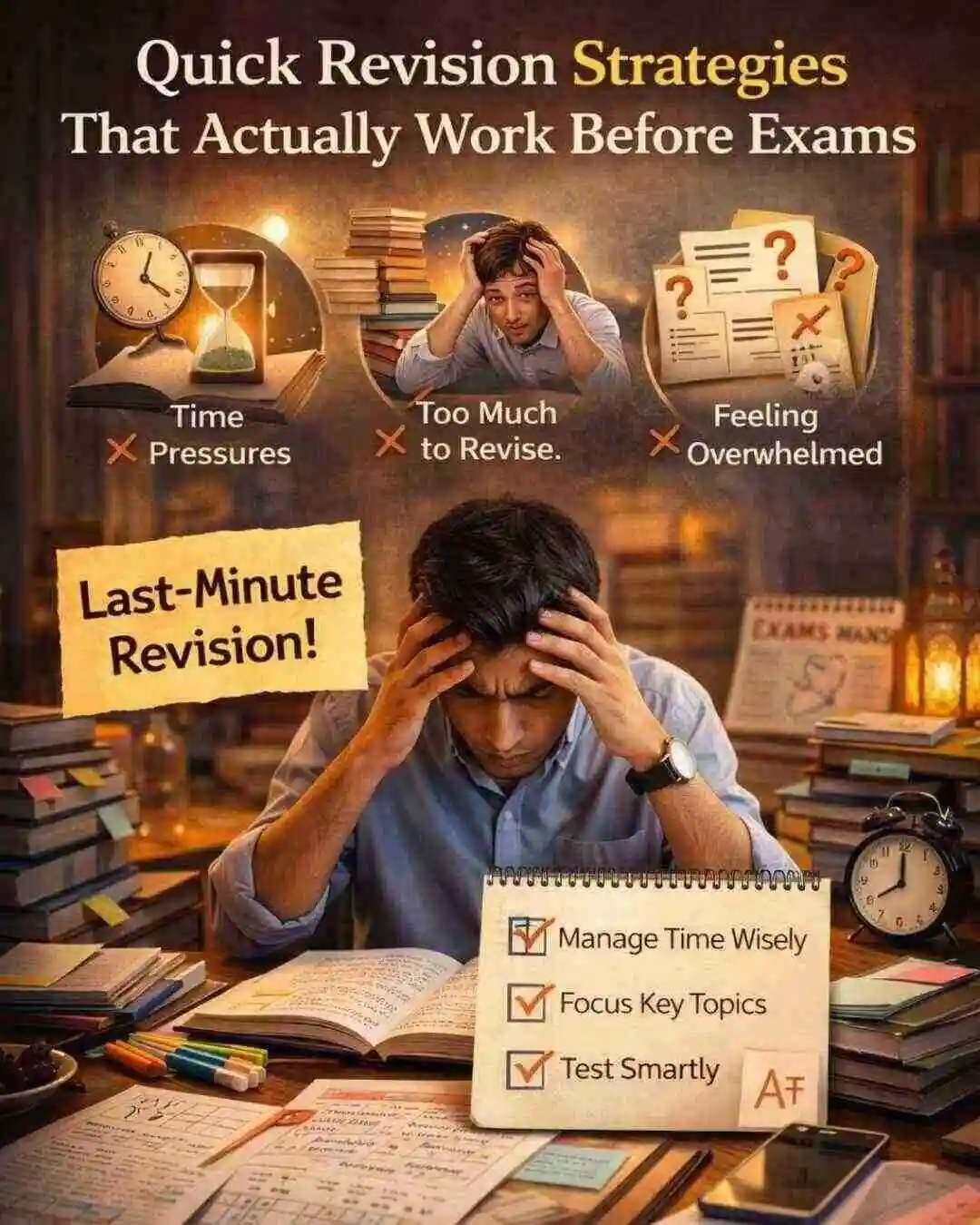
Quick Revision Strategies That Actually Work Before Exams.
Ever felt like there’s too much to revise and too little time left? You’re not alone. As exams get closer, even well-prepared students start looking for smarter ways to revise without feeling overwhelmed. The good news is that effective revision isn’t about studying longer hours, it’s about using the right strategies at the right time. In this blog, we’ll explore practical, easy-to-follow revision techniques that help you stay focused, organised, and confident before exams. If you want to make your remaining study time truly count, keep reading, you might find exactly what you need.
The Reality of Last-Minute Exam Preparation.
Let’s be honest – last-minute exam preparation is stressful. No matter how well you planned earlier, there’s always that moment when exams feel closer than expected. The syllabus looks bigger, time feels shorter, and panic slowly creeps in.
But here’s the truth: last-minute revision doesn’t have to mean chaos. What matters most is how you use the time you still have. This is where quick exam revision strategies make a real difference.
Why Students Struggle at the Last Moment.
Many students fall into common traps during last-minute exam preparation-
- Trying to revise the entire syllabus again.
- Rereading notes without testing understanding.
- Studying for long hours without breaks.
- Ignoring high-weightage topics.
Studying Smart vs Studying More.
At this stage, productivity matters more than hours. Instead of covering everything, focus on effective exam revision methods that maximise results in limited time.
Practical exam preparation tips include-
- Prioritising important and repeated topics.
- Practising past paper questions.
- Using active recall instead of passive reading.
- Creating short summary notes for quick review.
The goal isn’t perfection, it’s precision. When you shift from “I need to study everything” to “I need to study what matters most,” stress reduces and confidence grows.
Studying Smart vs Studying Long.
When exams are close, many students believe the solution is simple: study more hours. But here’s the honest truth, long hours don’t always mean better results. What truly makes a difference is how effectively you use your time. That’s where quick exam revision strategies come in.
What Studying Long Often Looks Like.
- Reading the same chapter multiple times.
- Highlighting pages without testing understanding.
- Jumping between subjects without a plan.
- Studying late at night with low concentration.
What Studying Smart Looks Like.
Using effective revision methods helps you get more done in less time. Instead of revising everything, focus on what’s most likely to appear in exams and what you find challenging.
Practical exam preparation tips include-
- Prioritising high-weightage and frequently tested topics.
- Practising past paper questions under timed conditions.
- Using active recall instead of passive reading.
- Revising in short, focused study blocks with breaks.
Studying smart means being selective and strategic. It’s about understanding exam patterns, identifying weak areas, and improving them quickly. Even two focused hours can outperform five distracted ones..
The 80/20 Rule in Quick revision strategies.
If you’re short on time, here’s a simple truth: not every topic carries equal weight in exams. The 80/20 rule suggests that roughly 20% of the syllabus often contributes to 80% of the marks. When used wisely, this idea becomes one of the most powerful quick exam revision strategies, especially during last-minute exam preparation.
Instead of trying to revise everything, focus on the topics that are tested frequently and carry higher marks. This doesn’t mean ignoring the rest, but it does mean being strategic about where you invest your time.

How to Apply the 80/20 Rule.
Start by identifying-
- High-weightage chapters.
- Frequently repeated questions from past papers.
- Core concepts that link to multiple topics.
- Areas where you tend to lose marks.
Why It Works.
During intense revision periods, energy and concentration are limited. Smart exam preparation tips focus on maximising returns from each study session. By revising key concepts thoroughly and practising likely question patterns, you build both confidence and scoring ability.
The 80/20 rule doesn’t encourage shortcuts, it encourages efficiency. It helps you avoid spreading yourself too thin and instead strengthens the areas that truly impact your performance.
Mind Maps and Quick Notes.
When exams are near, you don’t have time to reread entire textbooks. What you need are tools that help you revise faster and remember more. That’s where mind maps and quick notes become powerful quick exam revision strategies, especially during last-minute exam preparation.
Why Mind Maps Work.
Instead of studying topics in isolation, you connect ideas visually. This makes it easier to understand relationships between concepts and recall them during exams.
To create an effective mind map-
- Write the main topic in the centre.
- Branch out into key subtopics.
- Add formulas, keywords, or diagrams.
- Keep it simple and easy to scan.
This approach supports active learning and fits well with proven exam revision methods that focus on clarity over volume.
The Power of Quick Notes.
Quick notes are short, focused summaries of important concepts. They are not detailed explanations, they are reminders. Think of them as condensed revision sheets you can review in minutes.
Practical exam preparation tips for creating quick notes include-
- Highlight only key definitions and formulas.
- Write common mistakes to avoid.
- Add short examples or trigger words.
- Keep each topic limited to one page.
Mind maps and quick notes reduce overwhelm. Instead of staring at thick textbooks, you work with structured, easy-to-review material. In high-pressure situations, simplicity wins. When your revision tools are clear and focused, your preparation becomes faster, smarter, and far more effective.
Don’t Try to Study Everything.
When exams are close, the biggest mistake students make is trying to cover the entire syllabus again. It feels productive but in reality, it often leads to panic and exhaustion. One of the most practical quick exam revision strategies is learning what not to study.
Why Studying Everything Backfires.
When you try to do too much at once-
- You spend less time on high-weightage topics.
- Important concepts don’t get enough practice.
- Stress levels increase.
- Revision becomes rushed and ineffective.
What You Should Do Instead.
Smart exam preparation tips focus on selective and strategic revision. Start by identifying-
- Topics that carry more marks,
- Frequently repeated questions.
- Concepts you struggle with.
- Areas that connect multiple chapters.
Once identified, allocate most of your time there. This ensures better understanding and stronger recall.
Think of revision like packing for a short trip. You don’t carry everything, only what you truly need. The same logic applies to exams. When you focus on the right areas, revision feels lighter and more manageable.
Managing Stress During Revision.
Revision isn’t just about books and notes, it’s also about managing your mindset. Even the best quick exam revision strategies won’t work if stress takes over. A little pressure can push you to focus, but too much can block memory, reduce concentration, and affect performance.
Why Stress Affects Performance.
When you’re anxious-
- Your focus becomes scattered.
- You forget concepts you already know.
- Small doubts feel bigger than they are.
- Revision feels heavier than it should.
That’s why effective exam revision methods must include stress management as part of the plan.
Practical Ways to Stay Calm.
Here are simple but powerful exam preparation tips you can apply immediately-
- Study in short, focused sessions (40–50 minutes), then take a 5–10 minute break.
- Avoid comparing your progress with others.
- Practise deep breathing before starting a revision session.
- Sleep at least 6–7 hours before exams.
- Keep one small achievement goal for each study block.
Another helpful strategy is writing down what’s worrying you. Often, stress feels bigger in your head than on paper. Once you see it clearly, it becomes manageable.
Remember, revision is not a race. It’s a process of strengthening what you already know. When you combine smart quick exam revision strategies with calm thinking, your efficiency improves naturally.
Building Confidence Through Practice for quick revision strategies.
Confidence doesn’t come from reading more, it comes from practising more. One of the most effective quick exam revision strategies is turning revision into active problem-solving rather than passive reading. The more you apply what you study, the more natural it feels in the exam hall.

Why Practice Changes Everything.
When you practise regularly-
- You understand how questions are framed.
- You improve speed and accuracy.
- You identify weak areas quickly.
- You reduce fear of unexpected questions.
Smart Ways to Practise Effectively.
Here are practical exam preparation tips to strengthen confidence-
- Solve at least one timed paper every few days.
- Review mistakes immediately after practice.
- Focus more on application-based questions.
- Track repeated errors and revise those topics again.
In the end, confidence isn’t built overnight. It grows through consistent action. When you combine structured practice with quick exam revision strategies, you don’t just prepare for exams, you prepare your mind to handle them calmly and effectively.
Conclusion
Preparing for exams doesn’t have to feel overwhelming when you follow the right approach. Using smart and focused quick exam revision strategies can make a huge difference, especially during last-minute exam preparation. Instead of studying for long hours without direction, it’s more effective to study with clarity, prioritise important topics, practise regularly, and manage stress wisely.
Simple exam preparation tips like timed practice, structured revision plans, and focusing on high-weightage areas help improve both understanding and confidence. When preparation is organised and balanced, students walk into exams feeling calm, prepared, and self-assured. In the end, success in exams is not just about hard work, it’s about smart revision, steady practice, and believing in your preparation. For more details WhatsApp us at 0503765193
Frequently Asked Questions (FAQs).
Q. What are the best quick exam revision strategies before exams?
The best quick exam revision strategies focus on high-weightage topics, practising previous papers, timed mock tests, and reviewing weak areas. Smart revision is more effective than long, unstructured study sessions.
Q. How can I manage last-minute exam preparation effectively?
Prioritise important chapters, create a short revision schedule, practise exam-style questions, and avoid trying to study everything. Staying calm and organised is key.
Q. Are exam preparation tips really helpful in the final days?
Yes. The right exam preparation tips help improve focus, reduce stress, and strengthen confidence. Even small changes in strategy can significantly improve performance.
Q. What exam revision methods improve confidence the most?
Active practice, solving past papers, correcting mistakes immediately, and revising key concepts repeatedly build strong confidence before exams.
Q. How can I avoid common revision mistakes?
Avoid cramming, skipping practice questions, ignoring sleep, or revising without a plan. Structured and balanced preparation always works better.
Need Personalised Support?
If you feel stuck or want expert guidance to strengthen your revision, we’re here to help. At Future Ethics Academy, we provide focused support, smart revision planning, and exam-oriented practice to help students prepare with clarity and confidence.
👉 Visit futureethicsacademy to explore our programmes and take the next step toward stress-free exam success.