Starting Class 11? Here’s How to Prepare for Physics from Day One (2026 Guide).
Physics just got real and so did your syllabus. If you’ve just stepped into Class 11, chances are you’ve already heard the horror stories- Physics is so hard, I failed in the first unit test, or I wish someone had told me this earlier. The good news? You’re reading this on Day One, and that changes everything. Class 11 Physics isn’t about memorising formulas, it’s about understanding how the world actually works. In this guide, we’ll walk you through exactly how to prepare for class 11 physics from the beginning, so you don’t just survive the year, you actually enjoy it.
Why Class 11 Physics Feels Harder (And Why That’s Okay).
Most students find Class 11 Physics shocking not because it’s impossible, but because it’s a big leap from Class 10. In Class 10, you mostly memorised definitions. In Class 11, you’re expected to apply concepts, solve numericals, and think logically. That shift catches a lot of students off guard.
Here’s what actually changes-
- The syllabus is concept-heavy, not fact-heavy.
- Numericals require both formula knowledge and problem-solving thinking.
- Topics like Kinematics and Laws of Motion form the base of JEE and NEET.
- You’re building a foundation for Class 12, every chapter connects forward.
Understanding this upfront helps you approach the subject with the right mindset, not fear, but preparation.
Know Your Syllabus Before You Open a Single Book.
Before anything else, understand what you’re going to study. The CBSE Class 11 Physics syllabus 2026 has 14 chapters spread across two NCERT books. Knowing the class 11 important chapters 2026 helps you prioritise smartly from day one.
High-Weightage Chapters to Focus On First.
- Kinematics (Unit 2) – the starting point for everything in Mechanics.
- Laws of Motion (Unit 3) – Newton’s laws with real-world applications.
- Work, Energy and Power (Unit 4) – important for both boards and JEE/NEET.
- Thermodynamics (Unit 8) – concept-driven and highly scoring.
- Oscillations and Waves (Units 9 & 10) – formula-driven, great for quick marks.
The CBSE Class 11 chapter wise weightage 2026 shows that Mechanics alone covers around 40–45% of your theory paper. Start there, build your base strong, then move chapter by chapter.
How to Prepare for Physics – Class 11 Physics Study Plan That Actually Works.
One of the biggest mistakes students make is diving into chapters without a plan. A class 11 study plan for beginners doesn’t need to be complicated, it just needs to be consistent.
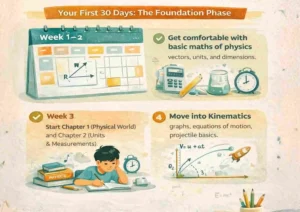
Your First 30 Days, The Foundation Phase.
- Week 1–2- Get comfortable with basic maths of physics – vectors, units, and dimensions.
- Week 3- Start Chapter 1 (Physical World) and Chapter 2 (Units & Measurements).
- Week 4- Move into Kinematics – graphs, equations of motion, projectile basics.
Your class 11 timetable for the first month should have at least 1 to 1.5 hours dedicated to Physics every day. Don’t rush through chapters – depth matters far more than speed in this subject.
The Ideal Daily Routine for Physics-
- 20 minutes: Revise yesterday’s concepts or formulas.
- 40 minutes: Study a new topic – theory first, then examples.
- 20 minutes: Solve 3–5 numericals from the chapter.
- 10 minutes: Write down doubts to clear the next day.
This structure is simple but powerful. Following it from Day One is exactly how to start studying physics in Class 11 the right way.
Choose the Right Books – Don’t Overload Yourself.
Ask any topper about the best books for class 11 physics CBSE 2026, and they’ll give you the same answer: start with NCERT and master it completely before picking up anything else.
Book Strategy for Beginners-
- NCERT Physics Part I & II – JEE/NEET.
- H.C. Verma (Concepts of Physics) – once NCERT is solid, use this for deeper understanding and tough numericals.
- DC Pandey (Arihant) – excellent for topic-wise practice questions.
- NCERT Exemplar – must-solve for higher-order thinking questions in boards.
Many students make the mistake of buying 4 – 5 books at once. Resist that urge. Follow this NCERT class 11 physics tip: read every line carefully, solve every in-text question, and understand every diagram. That alone can get you 80%+ in board exams.
Preparing for JEE or NEET? Start the Foundation Right Now.
If you’re targeting engineering or medicine, then class 11 physics preparation for JEE from day one is not optional, it’s essential. Around 45–50% of JEE Physics comes directly from Class 11 topics. Similarly, students wondering how to study class 11 physics for NEET should know that NEET also carries a significant share from Class 11 Physics.
Crucial Topics for JEE & NEET from Class 11.
- Kinematics and Rotational Motion – numerically intensive, very high weightage.
- Thermodynamics – concept-based, easy to score once understood well.
- Gravitation – moderate difficulty, appears frequently in NEET.
- Waves and Oscillations – formula-driven and highly scoring.
- Laws of Motion and Work-Energy Theorem – foundational for both exams.
For building a class 11 physics foundation for JEE NEET 2028, the strategy is simple: don’t treat school prep and competitive prep as two different things. Build concepts deeply at school level – your JEE/NEET foundation gets stronger automatically.
Mastering Class 11 Physics Numericals – The Real Game Changer.
Most students fear numericals. But here’s the truth: numericals are the most predictable part of Physics. Once you understand the formula and the logic behind it, the same type of problem appears again and again, just with different numbers.
How to Approach Numericals as a Beginner.
- Always write down what’s given and what’s asked – this alone clears 50% of the confusion.
- Identify the correct formula before plugging in any numbers.
- Check units at every step – unit errors are the most common mistakes beginners make.
- Solve at least 10 numericals per chapter before moving to the next one.
- Use NCERT solved examples as templates for your problem-solving approach.
The best class 11 physics numericals tips for beginners: don’t memorise solutions – understand the method. One understood method beats ten memorised answers every single time.
5 Common Mistakes to Avoid in Class 11 Physics.
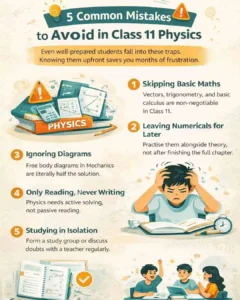
Even well-prepared students fall into these traps. Knowing them upfront saves you months of frustration.
- Skipping basic maths – vectors, trigonometry, and basic calculus are non-negotiable in Class 11.
- Leaving numerical for later – practise them alongside theory, not after finishing the full chapter.
- Ignoring diagrams – free body diagrams in Mechanics are literally half the solution.
- Only reading, never writing – physics needs active solving, not passive reading.
- Studying in isolation – form a study group or discuss doubts with a teacher regularly.
If you’re thinking “class 11 is hard, what do I do?” – chances are one of these habits is the real culprit. Fix the habit, and the subject gets much more manageable.
Revision Strategy That Actually Sticks.
Studying once is never enough. The secret to retaining everything is a smart, consistent revision cycle.
- Revise each chapter within 24 hours of studying it – this locks concepts into memory.
- Do a weekly revision every Sunday – cover all chapters studied that week.
- Maintain a dedicated formula notebook – write every formula by hand and review it daily.
- Start solving CBSE sample papers and previous year question papers from November onwards.
A good revision cycle also directly supports your class 11 physics preparation for JEE from day one, since competitive exams reward long-term retention over last-minute cramming.
How to Prepare for Physics Don’t Ignore Practicals – They’re 30 Free Marks.
The Class 11 Physics practical exam carries 30 marks, that’s a significant portion of your total score. Students who take practicals seriously walk in with 25-28 marks already secured before the theory paper even begins.
- Understand the procedure and logic of each experiment, not just the outcome.
- Maintain a neat and complete practical record from the very first lab session.
- Prepare for viva-voce questions, they’re almost always from your own lab experiments.
- Don’t treat practicals as a formality, they actually reinforce your theory concepts brilliantly.
Conclusion
Class 11 rewards patience and consistency above everything else. If you know How to Prepare for Physics from the beginning, you’re already miles ahead of most of your classmates. Start with NCERT, build your foundation in Mechanics, follow a daily study plan, and never skip numericals. Whether you’re preparing for boards, JEE, or NEET, everything you build in Class 11 will carry you forward. The right time to start isn’t Monday – it’s today. Stay curious, stay consistent, and Physics will start making a lot more sense than you ever thought it would.
Frequently Asked Questions (FAQs)
Q. Do Class 11 Physics concepts appear in Class 12 boards?
Yes, around 25–30% of Class 12 board paper concepts are rooted in Class 11 topics. Subjects like Kinematics, Laws of Motion, Work-Energy Theorem, and Thermodynamics directly connect to Class 12 chapters. A strong Class 11 foundation genuinely makes Class 12 Physics significantly easier.
Q. What are the most important chapters in Class 11 Physics for JEE and NEET?
For both JEE and NEET, the most important Class 11 Physics chapters are Kinematics, Laws of Motion, Work-Energy and Power, Rotational Motion, Gravitation, Thermodynamics, and Waves. Kinematics and Rotational Motion carry the highest numerical weightage in JEE, while Gravitation and Thermodynamics are frequently tested in NEET.
Q. Are derivations important in Class 11 Physics exams?
Yes, absolutely. Derivations typically carry 3 to 5 marks each in board exams and appear consistently year after year. They also help you understand where formulas come from, which makes it easier to remember and apply them correctly in numericals. Never skip derivations.
Q. Can I prepare for JEE and NEET simultaneously while doing Class 11?
Yes and in fact, Class 11 is the best time to start. The school syllabus and JEE/NEET syllabus overlap almost completely in Physics. Build deep conceptual understanding at school level first. Don’t treat them as two separate preparations, one strong Class 11 Physics base automatically strengthens your JEE/NEET foundation.
Q. Is NCERT enough to score good marks in Class 11 Physics?
For CBSE board exams, NCERT is more than enough if studied thoroughly, every line, every solved example, every diagram. Most board questions are directly or indirectly based on NCERT. For competitive exams like JEE and NEET, you’ll need additional books like H.C. Verma or DC Pandey once your NCERT base is strong.
Recommended also to read
Signs Your Child Needs Extra Exam Preparation Support
Quick Revision Strategies That Actually Work Before Exams.
Is Private Tuition Worth It for Exams in UAE?