
Signs Your Child Needs Extra Exam Preparation Support.
Every parent wants their child to walk into an exam hall feeling confident, but what if yours is quietly struggling? It’s not always easy to tell. Your child might seem fine on the surface going to school, doing homework, nodding when you ask if they’re okay. But sometimes, the signs that they need a little extra exam support are hiding in plain sight.
Maybe they’re spending hours studying but still not retaining anything. Maybe exam time brings tears, frustration, or that familiar last-minute panic. Sound familiar? You’re not alone and more importantly, you’re in the right place. In this blog, we’ll walk you through the key signs to look out for, so you can step in early and give your child the support they truly deserve.
In this blog, we walk you through the key signs to watch for, why they matter, and what you can do to help your child move forward with confidence.
Why Extra Exam Preparation Support Matters.
Many children struggle silently during exam season. They may not have the words to explain what they are feeling, or they may fear disappointing their parents by admitting they are finding things difficult. This silence can lead to a cycle of poor performance, declining confidence, and increasing anxiety all of which are entirely preventable with the right support in place.
Early intervention is key. The sooner you identify that your child needs extra help, the more time there is to put meaningful strategies in place before exam day arrives.
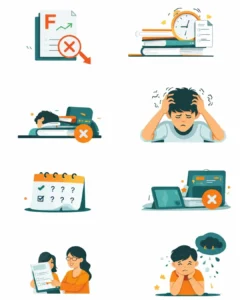
7 Signs Your Child Needs Extra Exam Preparation Support.
01
Grades Are Consistently Declining.
One of the clearest indicators is a noticeable drop in grades or test scores over time. If your child was previously performing well and has begun slipping, this is a signal worth investigating rather than dismissing. A downward trend, even a gradual one, often reflects gaps in understanding that will compound as exam pressure increases.
02
They Spend Hours Studying but Retain Very Little.
Effort does not always equal effectiveness. If your child is putting in hours at the desk yet cannot recall what they studied, it is likely they are using ineffective revision methods. Without proper exam preparation strategies, such as active recall, spaced repetition, or past paper practice, study time can feel productive while achieving very little.
03
Visible Exam Anxiety or Emotional Distress.
Physical symptoms such as headaches, sleep disturbances, loss of appetite, or frequent stomach aches before exams can all be signs of exam-related anxiety. Equally, emotional responses like irritability, tearfulness, or complete withdrawal from family conversations about school should be taken seriously. Anxiety affects performance, and it is not something children simply “grow out of” without support.
04
Avoidance of Studying or Homework.
Procrastination and avoidance are rarely about laziness. When a child consistently avoids their books, makes excuses to delay studying, or becomes easily distracted, it often signals that they feel overwhelmed or lack confidence in the subject. Avoidance is a coping mechanism, one that ultimately makes the problem worse without intervention.
05
Lack of a Study Plan or Revision Strategy.
Many children simply do not know how to prepare for exams effectively. Without a structured revision timetable, clear goals, and a method for reviewing material, exam preparation can feel aimless and chaotic. If your child does not have a plan, or struggles to stick to one, extra academic support can help them develop the organisational skills needed to study smarter, not just harder.
06
Low Confidence or Negative Self-Talk.
Phrases like “I’m just not good at this,” “There’s no point trying,” or “I’m going to fail anyway” are more than passing comments, they reflect a fixed mindset that can be deeply limiting. Low academic confidence often develops after a series of disappointing results, and it can prevent children from engaging with their studies at all. A supportive tutor or preparation programme can help rebuild that confidence in a structured, encouraging environment.
07
Teachers Are Raising Concerns.
If your child’s school teacher has flagged concerns about their academic progress, attention in class, or preparedness for upcoming assessments, it is important to take that feedback seriously. Teachers are often the first to observe the early signs of struggle, and their insights can be invaluable in determining what kind of support your child needs.
What You Can Do to Help for Extra Exam Preparation Support.
If you have identified one or more of the signs above in your child, the first step is to open a calm, non-judgmental conversation. Ask open-ended questions, not “why aren’t you studying?” but “how are you feeling about your upcoming exams?” Creating a safe space for your child to express their concerns without fear of disappointment is essential.

Practical Steps to Support Your Child-
- Speak to your child’s teacher or school counsellor to understand where specific gaps lie.
- Help your child build a realistic and structured revision timetable with regular breaks.
- Introduce proven study techniques such as practice tests, flashcards, and mind maps.
- Consider enrolling your child in a professional exam preparation programme or hiring a subject tutor.
- Limit distractions during study time and create a calm, dedicated revision space at home.
- Praise effort and progress, not just results, this builds resilience and long-term motivation.
When to Seek Professional Exam Support.
If your child’s struggles persist despite your best efforts at home, professional Extra Exam Preparation Support may be the most effective route forward.
A skilled tutor or specialist programme can identify the exact areas where your child is falling behind, provide targeted practice, and – crucially – rebuild the academic confidence that is so often lost during difficult exam periods.
Spotted These Signs in Your Child? Future Ethics Academy Can Help.
You are not alone and the good news is, it is never too late to turn things around.
At Future Ethics Academy (FEA), we specialise in helping CBSE and ICSE students from Grades 5 to 12 build strong subject foundations, overcome exam anxiety, and walk into every assessment feeling genuinely prepared. Trusted by over 2,500 students across the UAE, our expert tutors bring more than 12 years of teaching experience to every single session.
We know that every child learns differently. That is why FEA offers personalised one-on-one live sessions as well as small group batches, so your child gets the right level of attention, at the right pace, in a supportive and encouraging environment.
Here is how Future Ethics Academy helps students overcome exam struggles-
- Personalised 1-on-1 or small group sessions tailored to your child’s specific needs.
- Expert tuition in Physics, Chemistry, Biology, Mathematics, and Science.
- Regular mock tests, simulated exams, and detailed error analysis reports.
- Dedicated doubt-clearance sessions so no question ever goes unanswered.
- Exam-focused preparation aligned with the latest CBSE and ICSE patterns.
- Comprehensive study material designed by experienced faculty.
- A proven approach that builds not just exam scores – but genuine confidence and conceptual clarity.
Whether your child is falling behind in a specific subject, struggling to retain information, or simply needs a structured study plan to get exam-ready- FEA has the right programme for them.
Take the first step today – it is completely free.
Because at Future Ethics Academy, we do not just teach subjects, we build futures.
Final Thoughts
Every child is different, and there is no single definition of “struggling.” What matters is that you stay attentive, keep the lines of communication open, and act early when something does not feel right. The signs outlined in this blog are not causes for alarm, they are opportunities to step in with the right support before small challenges become significant setbacks.
Your child’s potential is not defined by a single exam result. With the right preparation, the right support, and the right mindset, every child has the ability to walk into that exam hall feeling ready, capable, and confident.
FREQUENTLY ASKED QUESTIONS-
Q. At what age should I start thinking about exam preparation support for my child?
It is never too early to build good study habits, but structured exam preparation typically becomes relevant from around age 9–10 (Year 5 upwards), particularly as children approach key assessments such as 11+, SATs, GCSEs, or A-levels.
Q. How do I know if my child’s struggles are temporary or a sign of a deeper issue?
A single poor test result is rarely cause for alarm. However, if your child shows a consistent pattern of declining grades, avoidance of studying, emotional distress around exams, or difficulty retaining information over several weeks or months, it is worth investigating further. Speaking with their teacher is a good first step to understanding whether the challenges are subject-specific or more widespread.
Q. My child studies for hours but still fails, what could be wrong?
The issue is almost always one of method rather than effort. Many children study passively, re-reading notes or highlighting text, which creates a false sense of familiarity without genuine retention. Effective revision involves active techniques such as practice testing, past paper work, spaced repetition, and self-quizzing. A tutor or exam preparation programme can help your child switch to strategies that actually work.
Q. What is the difference between a tutor and an exam preparation programme?
A private tutor typically provides one-to-one sessions focused on specific subjects or knowledge gaps. An exam preparation programme, on the other hand, is more structured and often covers exam technique, time management, revision strategy, and confidence building alongside the academic content. The best choice depends on your child’s specific needs, subject-level support, general study skills, or both.
Q. How much extra study time should my child be doing outside school?
There is no universal answer, as it depends on the child’s age, upcoming exams, and current level of preparedness. As a general guide, younger children (ages 9–11) benefit from 20–30 minutes of focused revision daily, while older students (ages 14–18) may need 1–3 hours. Quality and consistency matter far more than volume, daily short sessions consistently outperform last-minute marathon cramming.
Q. Can exam support really make a significant difference to results?
Yes, research consistently shows that structured revision, targeted feedback, and improved study habits have a measurable positive impact on exam performance. Beyond grades, effective exam preparation also reduces anxiety, builds academic confidence, and equips children with skills they will use throughout their education and professional life.
Q. What should I look for when choosing an exam preparation tutor or service for Extra Exam Preparation Support?
Look for a tutor or service that takes time to assess your child’s specific needs before beginning, uses evidence-based teaching methods, provides regular progress updates, and creates a supportive rather than pressured learning environment. Qualifications are important, but so is a tutor’s ability to build rapport with your child, engagement and trust are fundamental to effective learning.