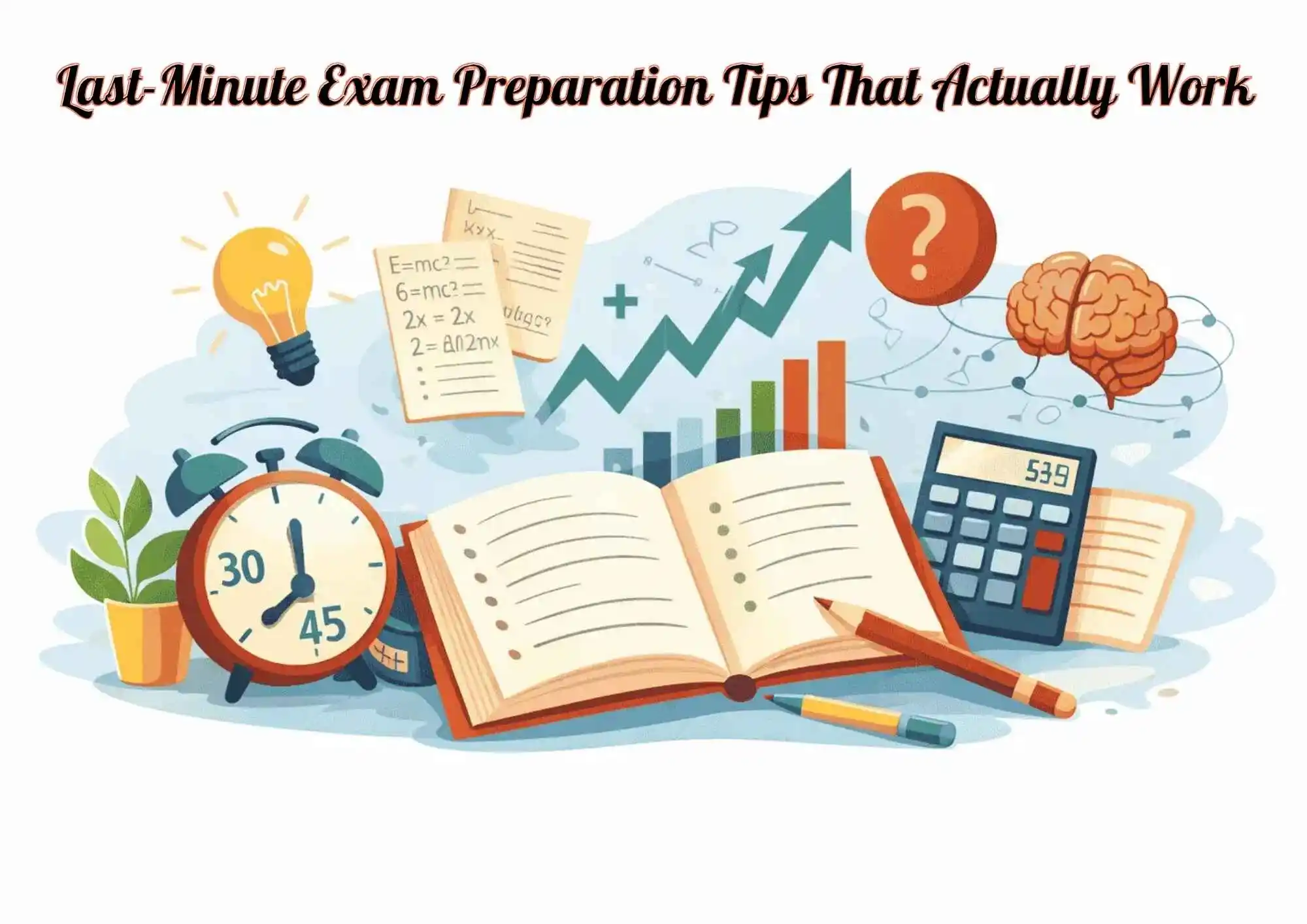
Last-Minute Exam Preparation Tips That Actually Work
Exams are just around the corner, and suddenly the clock feels like it’s moving faster than ever. If you’re running out of time and wondering how to revise effectively without panicking, you’re not alone. Last-minute exam preparation can feel stressful, but when done the right way, it can still make a real difference. In this blog, we’ll share practical exam preparation tips and quick revision strategies that actually work when time is limited. From choosing what to revise first to staying calm under pressure, you’ll discover simple, smart ways to make the most of the time you have left.
Why Last-Minute Exam Preparation Works
Last-minute exam preparation often has a bad reputation, but the truth is that it can be effective when done the right way. When time is limited, your focus naturally sharpens. You stop overthinking and start paying attention to what really matters. Instead of trying to study everything, you prioritise the most important topics, which makes revision more effective and less overwhelming.
Rather than passively reading notes, students tend to practise questions, revise key formulas, and test themselves. These methods help information stick better, especially when exams are just days or hours away.
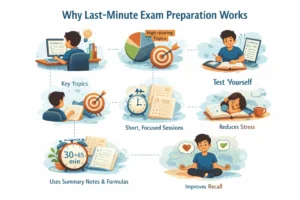
Another advantage is better time management. With limited time, students are more likely to plan short, focused study sessions. Simple, quick exam revision strategies, such as revising summaries, solving exam-style questions, and reviewing mistakes, help students make real progress in a short period.
That said, last-minute exam preparation works best when it’s structured. Random revision or cramming new topics rarely helps. Instead, students should focus on-
- High-weightage topics.
- Frequently asked questions.
- Key concepts and formulas.
Use Smart Exam Preparation Tips
It’s natural to feel anxious and rushed. At this stage, last-minute isn’t about learning everything from scratch- it’s about making smart choices that help you perform better with the time you have left.
The first thing to understand is that trying to study everything at the last minute usually backfires. Instead, effective preparation starts with prioritising. Ask yourself which topics are most important, which ones you already understand reasonably well, and where you can realistically improve in a short time.
Here are some exam preparation tips that truly help when time is limited-
- Start with high-scoring topics
Focus on chapters and concepts that carry more marks or appear frequently in exams. This gives you the best return on your effort. - Switch from reading to doing
Passive reading feels productive, but it doesn’t always help during exams. Solving questions, recalling formulas from memory, and explaining concepts aloud are far more effective. - Use short, focused study sessions
Instead of studying for hours non-stop, revise in 30 – 45 minute blocks. Short breaks help your brain absorb information better and reduce fatigue. - Keep revision material simple
At this stage, summary notes, formula sheets, and key points work better than heavy textbooks. These are essential quick exam revision strategies that save time. - Practise under exam-like conditions
Try solving a few questions with a timer. This improves speed, accuracy, and confidence.
Most importantly, stay calm. Stress can make even familiar topics feel difficult. Trust your preparation, follow these strategies, and remind yourself that smart revision is far more powerful than panic-driven cramming.
Stay Calm and Confident
When exams are close, staying calm can feel just as challenging as studying itself. During last-minute exam preparation, anxiety often builds up not because students don’t know the material, but because of pressure and fear of forgetting things.
One of the most important preparation tips is to trust what you’ve already studied. At this point, revisiting everything can create confusion. Instead, focus on reinforcing familiar topics and sharpening your strengths. This helps your brain feel more in control and reduces panic.
It’s necessary to take care of your mental and physical state. Lack of sleep or constant stress can affect memory and focus, no matter how well you’ve revised. Small changes in routine can make a big difference during last-minute exam preparation.
Here are a few simple ways to stay calm and confident-
- Breathe and slow down when stress builds deep breathing helps clear your mind.
- Stick to short revision sessions to avoid burnout and stay focused.
- Use quick exam revision strategies like formula review and solved examples instead of learning new topics.
- Avoid comparing yourself to others, as it often increases anxiety.
- Prepare the night before, including stationery and exam essentials, to reduce last-minute stress.
Confidence grows when preparation feels organised. Remember, staying calm isn’t about being perfect, it’s about being focused, prepared, and believing in yourself.
High-Scoring Revision Techniques
The goal of exam preparation is simple. High-scoring revision is about focusing on methods that improve recall, accuracy, and confidence, especially when time is limited.
Revise actively instead of passively.
Reading notes again and again may feel safe, but it doesn’t always help during exams.
challenge your brain by recalling information without looking at your notes. This strengthens memory and prepares you for real exam conditions.
Another smart approach is to focus on exam patterns. Knowing how questions are framed can save valuable time during the exam. Solving previous years’ questions or sample papers helps you understand what examiners expect and where students commonly lose marks.
Here are some quick exam revision strategies that actually work-
- Create short summary sheets for formulas, definitions, and key concepts.
- Practise high-weightage questions rather than revising every topic equally.
- Time yourself while solving problems to improve speed and accuracy.
- Review common mistakes you’ve made in tests or assignments.
- Explain answers out loud as if you’re teaching someone else, this improves clarity.
Revise smartly, not for long hours. Short, focused sessions are far more effective during last-minute exam preparation. Take small breaks to reset your mind and avoid fatigue.
High-scoring revision doesn’t mean covering everything, it means covering the right things well. By using practical exam preparation tips and focused quick exam revision strategies, you can make the most of the time you have and walk into the exam feeling prepared and confident.
Avoid Common Last-Minute Mistakes
When exams are close, even well-prepared students can make mistakes that affect performance. During last-minute, it’s not just about what you do, but also about what you avoid. Many students panic and fall into habits that waste time and increase stress instead of helping them revise effectively. One common mistake is trying to learn entirely new topics at the last moment. At this stage, revision should focus on strengthening what you already know rather than starting something unfamiliar.
Another issue is unplanned studying. Jumping between chapters without a clear structure makes it harder to retain information. Smart exam tips always emphasise having a simple plan, even if time is limited. Random revision usually leads to mental fatigue.
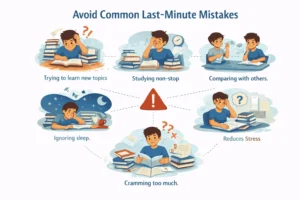
Here are some common last-minute mistakes to avoid-
- Overloading yourself with too much information in a short time.
- Studying non-stop without breaks, which reduces focus.
- Comparing your preparation with others, causing unnecessary stress.
- Ignoring sleep and rest, which affects memory and concentration.
- Relying only on reading notes, instead of practising questions.
Poor time management is another frequent problem. Many students spend too much time on one topic and rush through others. Using quick exam revision strategies, such as timed practice and topic-wise revision, helps maintain balance and control.
Finally, don’t underestimate the importance of mindset. Fear and negative thinking can block recall, even if you’ve studied well. Trust your preparation and stay focused on your plan.
Avoiding these common mistakes allows your last-minute exam preparation to be calm, structured, and effective, helping you walk into the exam with clarity and confidence.
Conclusion
Feeling a little calmer now? Or are you tempted to go back and revise just one more section?
If there’s one thing we hope you take away from this blog, it’s that last-minute exam preparation doesn’t have to feel chaotic or scary. With the right exam preparation tips, a calm mindset, and even limited time can be used wisely. Confidence comes from clarity, not cramming.
Of course, with so many tips available online, it’s easy to feel confused about what actually works. But here, you’ve been served something more practical, structured, and student-friendly something you can actually apply.
And if you ever feel stuck or need extra support, reaching out to the right guidance can make all the difference. At Future Ethics Academy, we support students from Grade 9 to Grade 12 with focused exam preparation, concept clarity, and confidence-building strategies, especially when it matters most.
You don’t have to do it all alone. Sometimes, a little expert guidance is all it takes to turn stress into success.
Frequently Asked Questions (FAQs)
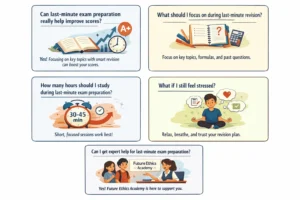
Q: Can I get expert help for last-minute exam preparation?
Absolutely. At Future Ethics Academy, we support students from Grades 9 to 12 with structured revision, concept clarity, and confidence-building guidance.
👉 DM us on whatsapp to get the right support when you need it most.
Q: Can last-minute exam preparation really help improve scores?
Yes, it can. When done correctly, last-minute exam preparation helps you focus on high-impact topics, revise smartly, and build confidence before the exam.
Q: What should I focus on during last-minute revision?
Prioritise important topics, formulas, and commonly asked questions. Avoid starting new chapters and use quick exam revision strategies for better recall.
Q: How many hours should I study during last-minute exam preparation?
Quality matters more than quantity. Short, focused study sessions with breaks are more effective than long, tiring hours.
Q: What if I still feel stressed despite revising?
Feeling nervous is normal. Try simple relaxation techniques, stick to your revision plan, and trust the exam preparation tips you’ve followed.
Recommended also to read
Top Physics Tutor in Dubai for Guaranteed Exam Preparation Results
Best Physics Tutor in Sharjah for CBSE, ICSE and IB Curriculum
Find the Right High School Physics Tutor in UAE
2 Comments
read more
February 19, 2026My family members every time say that I am killing my
time here at net, but I know I am getting know-how all the time by
reading thes fastidious posts.
FutureEthicsAcademy07
March 20, 2026Learning consistently, even through reading, is never a waste of time. Glad you’re finding value here—keep exploring!